Check out this News Release from USGS regarding the results of their otter census this past spring!
California Sea Otters – 2007 Survey Count Reaches New High
It will be interesting to find how many otters are in the slough this year!
Thank you to Renee, Team 7, 2006 for submitting this article.
Friday, July 13, 2007


Monday, July 02, 2007
THE STAFF
Principal Investigators

Daniela Maldini, Ph.D., is currently an Adjunct Professor in the Biology Department at the University of Massachusetts, Amherst. Daniela completed her B.S. degree in Biological Sciences at the University of Pavia, Italy, in 1988. During this time she managed the university’s marine biology laboratory and completed a thesis on the conservation biology of pleuronectiform fishes in the Ligurian Sea. She moved to the United States in 1988 and interned in the Oceanography Department at the University of Texas at Austin Marine Laboratory located in Corpus Christi, Texas. Later, she worked with marine mammals and birds at Moss Landing Marine Laboratories in Monterey Bay, California, where she completed her M.S. in Marine Sciences in 1996. The topic of her M.S. thesis was the ecology of bottlenose dolphins in Monterey Bay. During this time she was also involved in a variety of ecological studies focusing on whales, dolphins, sea otters, and pinnipeds; co-founded the Pacific Cetacean Group, a non-profit corporation focusing on research, education, and conservation; and led the Marine Mammal Center Monterey Bay Operations’ stranding network in 1994-1995. Daniela completed her Ph.D. in Zoology at the University of Hawaii at Manoa in 2003 with a study of odontocete abundance and distribution around the island of Oahu. She is also the co-founder and vice president of the Oceanwide Science Institute, a Hawaii non-profit organization. She has been contracting as a biologist with the Hawaiian Islands Humpback Whale National Marine Sanctuary since 1998. From 2001-2004 she worked as Research Associate at the Alaska SeaLife Center focusing on the ecology of killer whales and sea otters in Alaskan and Russian waters. Daniela is interested in behavioral ecology, population biology, and predator-prey relationships. Her work focuses on the ecology of odontocetes in various parts of the world.
 Thomas A. Jefferson, Ph.D., is a visiting scientist at the Southwest Fisheries Science Center, La Jolla, California. He has been studying marine mammals since 1983, and has conducted research on a variety of different species in the United States, Canada, Mexico, Peru, Africa, the Caribbean, and throughout Southeast Asia. He has published over 95 scientific papers and books, 10 popular articles, and one CD-ROM. Since 1995, Dr. Jefferson has been conducting research mainly on dolphins and porpoises in Southeast Asia, and leads a long-term project on Indo-Pacific humpback dolphins and finless porpoises in Hong Kong waters. He completed his Ph.D. in 1995 at Texas A&M University, working on cetaceans in offshore waters of the Gulf of Mexico. He also holds a M.S. in Marine Sciences completed while working at Moss Landing Marine Laboratories, in Monterey Bay, California. His primary interests are the systematics and conservation biology of small cetaceans.
 Research Coordinator - Cynthia Browning
Cynthia is an independent cetacean biologist who has been working on various field projects for the past five years. Originally from Long Island, NY, Cynthia moved to New Hampshire in 1999 to pursue a BS in Zoology from the University of New Hampshire. Cynthia’s primary interest in conservation led her to develop a deep interest in the North Atlantic Right Whale. Since completing her BS in 2003, Cynthia has worked on four different field projects, covering four out of the five critical habitats for right whales. Cynthia spends her winters with the Provincetown Center for Coastal Studies, flying aerial surveys as both an observer and the flight coordinator. For the past two years she has surveyed the offshore habitat of the Great South Channel with the New England Aquarium. During the late summer and fall, Cynthia moves up the coast to work in the Bay of Fundy (between northern Maine and Nova Scotia) and Roseway Basin (southeast of Nova Scotia). While she has worked with survey teams in these areas, Cynthia also was part of a groundbreaking project that collected whale scat in order to investigate the internal health of right whales. This will be Cynthia’s first year with the Marine Mammals of Monterey Project and she is excited to be part of the team.
Student Assistants – Stephanie Wallace, Andrew Walsh and Mark Cotter
Stephanie, Andrew and Mark are all undergraduate students at the University of Massachusetts at Amherst working with Dr. Maldini in various capacities. Stephanie is completing her senior thesis on sea otters under the supervision of Dr. Maldini. She will be coordinating sea otter observations and will welcome volunteer help in completing her data collection in the field. Andrew is also working with sea otters and Mark has been conducting photo-identification of dolphins for the past year.
Principal Investigators

Daniela Maldini, Ph.D., is currently an Adjunct Professor in the Biology Department at the University of Massachusetts, Amherst. Daniela completed her B.S. degree in Biological Sciences at the University of Pavia, Italy, in 1988. During this time she managed the university’s marine biology laboratory and completed a thesis on the conservation biology of pleuronectiform fishes in the Ligurian Sea. She moved to the United States in 1988 and interned in the Oceanography Department at the University of Texas at Austin Marine Laboratory located in Corpus Christi, Texas. Later, she worked with marine mammals and birds at Moss Landing Marine Laboratories in Monterey Bay, California, where she completed her M.S. in Marine Sciences in 1996. The topic of her M.S. thesis was the ecology of bottlenose dolphins in Monterey Bay. During this time she was also involved in a variety of ecological studies focusing on whales, dolphins, sea otters, and pinnipeds; co-founded the Pacific Cetacean Group, a non-profit corporation focusing on research, education, and conservation; and led the Marine Mammal Center Monterey Bay Operations’ stranding network in 1994-1995. Daniela completed her Ph.D. in Zoology at the University of Hawaii at Manoa in 2003 with a study of odontocete abundance and distribution around the island of Oahu. She is also the co-founder and vice president of the Oceanwide Science Institute, a Hawaii non-profit organization. She has been contracting as a biologist with the Hawaiian Islands Humpback Whale National Marine Sanctuary since 1998. From 2001-2004 she worked as Research Associate at the Alaska SeaLife Center focusing on the ecology of killer whales and sea otters in Alaskan and Russian waters. Daniela is interested in behavioral ecology, population biology, and predator-prey relationships. Her work focuses on the ecology of odontocetes in various parts of the world.
 Thomas A. Jefferson, Ph.D., is a visiting scientist at the Southwest Fisheries Science Center, La Jolla, California. He has been studying marine mammals since 1983, and has conducted research on a variety of different species in the United States, Canada, Mexico, Peru, Africa, the Caribbean, and throughout Southeast Asia. He has published over 95 scientific papers and books, 10 popular articles, and one CD-ROM. Since 1995, Dr. Jefferson has been conducting research mainly on dolphins and porpoises in Southeast Asia, and leads a long-term project on Indo-Pacific humpback dolphins and finless porpoises in Hong Kong waters. He completed his Ph.D. in 1995 at Texas A&M University, working on cetaceans in offshore waters of the Gulf of Mexico. He also holds a M.S. in Marine Sciences completed while working at Moss Landing Marine Laboratories, in Monterey Bay, California. His primary interests are the systematics and conservation biology of small cetaceans.
 Research Coordinator - Cynthia Browning
Cynthia is an independent cetacean biologist who has been working on various field projects for the past five years. Originally from Long Island, NY, Cynthia moved to New Hampshire in 1999 to pursue a BS in Zoology from the University of New Hampshire. Cynthia’s primary interest in conservation led her to develop a deep interest in the North Atlantic Right Whale. Since completing her BS in 2003, Cynthia has worked on four different field projects, covering four out of the five critical habitats for right whales. Cynthia spends her winters with the Provincetown Center for Coastal Studies, flying aerial surveys as both an observer and the flight coordinator. For the past two years she has surveyed the offshore habitat of the Great South Channel with the New England Aquarium. During the late summer and fall, Cynthia moves up the coast to work in the Bay of Fundy (between northern Maine and Nova Scotia) and Roseway Basin (southeast of Nova Scotia). While she has worked with survey teams in these areas, Cynthia also was part of a groundbreaking project that collected whale scat in order to investigate the internal health of right whales. This will be Cynthia’s first year with the Marine Mammals of Monterey Project and she is excited to be part of the team.
Student Assistants – Stephanie Wallace, Andrew Walsh and Mark Cotter
Stephanie, Andrew and Mark are all undergraduate students at the University of Massachusetts at Amherst working with Dr. Maldini in various capacities. Stephanie is completing her senior thesis on sea otters under the supervision of Dr. Maldini. She will be coordinating sea otter observations and will welcome volunteer help in completing her data collection in the field. Andrew is also working with sea otters and Mark has been conducting photo-identification of dolphins for the past year.
Monterey Bay - Welome to the 2007 Season !
Dear Past and Future Volunteers,
I am so excited to finally be able to launch the 2007 Season. I am getting ready to travel cross-country to Monterey Bay where I will be from mid-July to the end of October. It has been a long year for me, full of changes and new adventures. I just moved to North Carolina...Wilmington to be exact where my husband and trusted Director of Field Operations, Peter Nilsson, whom you have all grown to appreciate and love, has started a new job at the University of North Carolina, working with Marine Mammals on the East Coast.
I am very excited for him, but I am sad to say that he will not b e joining us in the field this year although he will be hard at work on the upcoming bottlenose dolphin book and catalogue that we are putting together, ... so stay tuned....
Our wonderful Field Assistant and Coordinator Anna Janovicz is pursuing her career at Earthwatch where she has been promoted (and she deserved it greatly!). SHe also will not be able to join us in the field this year and I wish her the best of luck with her new adventures. Thank you for keeping the blog alive Anna!!!
Thank you to all others that have contributed to the Blog through the winter. It is amazing to see how many wonderful contributions many of our past volunteeres have made to conservation through their workplace or personally. Keep it going, because individuals such as yourself can really make a big difference in the world today.
My winter has been spent working hard as Director of Research at Earthwatch. After some thinking, I have decided to move on and dedicate myself full-time to research and teaching since these are the things I love the most. This means that I will be able to do a full-season in the field with the upcoming teams and to spend time with the animals. I am very excited!
I will be starting to post the news more regularly now and I am hoping to be able to give you a glimpse of the findings so far.....
I am looking forward to forge new friendships and to revive old ones. Please keep in touch through the blog.
Sincerely
Daniela
Dear Past and Future Volunteers,
I am so excited to finally be able to launch the 2007 Season. I am getting ready to travel cross-country to Monterey Bay where I will be from mid-July to the end of October. It has been a long year for me, full of changes and new adventures. I just moved to North Carolina...Wilmington to be exact where my husband and trusted Director of Field Operations, Peter Nilsson, whom you have all grown to appreciate and love, has started a new job at the University of North Carolina, working with Marine Mammals on the East Coast.
I am very excited for him, but I am sad to say that he will not b e joining us in the field this year although he will be hard at work on the upcoming bottlenose dolphin book and catalogue that we are putting together, ... so stay tuned....
Our wonderful Field Assistant and Coordinator Anna Janovicz is pursuing her career at Earthwatch where she has been promoted (and she deserved it greatly!). SHe also will not be able to join us in the field this year and I wish her the best of luck with her new adventures. Thank you for keeping the blog alive Anna!!!
Thank you to all others that have contributed to the Blog through the winter. It is amazing to see how many wonderful contributions many of our past volunteeres have made to conservation through their workplace or personally. Keep it going, because individuals such as yourself can really make a big difference in the world today.
My winter has been spent working hard as Director of Research at Earthwatch. After some thinking, I have decided to move on and dedicate myself full-time to research and teaching since these are the things I love the most. This means that I will be able to do a full-season in the field with the upcoming teams and to spend time with the animals. I am very excited!
I will be starting to post the news more regularly now and I am hoping to be able to give you a glimpse of the findings so far.....
I am looking forward to forge new friendships and to revive old ones. Please keep in touch through the blog.
Sincerely
Daniela
Wednesday, April 25, 2007
Hi, I'm Tom Jefferson, one of the Principal Investigators for the project. I am looking forward to another exciting time in Monterey Bay this autumn, as our project enters its second year. We will again be collecting a wealth of information on bottlenose dolphins and sea otters of Monterey Bay, and this year we hope to do a bit more detailed work involving biopsy sampling and photogrammetry (measuring things with photos, that is).
We have put in several funding proposals and are now waiting to hear back the results. If we are successful in getting the additional funding, we will be able to do some very neat, state-of-the-art work with new biopsy equipment and special devices for our camera that will allow us to take measurements of dolphins' dorsal fins and get specific distance readings to the animals.
I have just finished the field work for a two-year project on Indo-Pacific humpback dolphins in Hong Kong . I am now in the process of analyzing all the data and writing up the final report. In this project, we biopsy-sampled 36 dolphins, mostly individual dolphins that we recognize by natural markings and have been observing for many years. Because we know these individuals so well, we are able to keep track of them after they are sampled, to see if there is any evidence of infection of the small wounds, or any changes in their range or behavior.
As we expected, the tiny biopsy wounds on the dolphins have healed fast, with no evidence of infection or any other adverse effects. Also, we have seen no indication of a change in behavior (other than a short-term reaction) of the sampled dolphins ñ they continue to hang out in the same areas, and sometimes approach our research boat, despite having been hit (sometimes more than once) with the biopsy dart! It seems that the procedure has little effect on the animals, and it is yielding a great jackpot of information about them and their environment.
On a personal note, I will be having major surgery on my left knee (injured in a mountain biking accident) in May, and will be slowly making my way back to full mobility and balance over the next few months. I should be fine by the time I begin fieldwork in SeptemberÖ
I am sure that this year in Monterey Bay, we will see some old friends (human, dolphin, and otter) and make some new ones as well. It promises to be very exciting and I know that the start of our field season will be here before we know it. I can't wait!
Take care,
Tom
We have put in several funding proposals and are now waiting to hear back the results. If we are successful in getting the additional funding, we will be able to do some very neat, state-of-the-art work with new biopsy equipment and special
 devices for our camera that will allow us to take measurements of dolphins' dorsal fins and get specific distance readings to the animals.
I have just finished the field work for a two-year project on Indo-Pacific humpback dolphins in Hong Kong . I am now in the process of analyzing all the data and writing up the final report. In this project, we biopsy-sampled 36 dolphins, mostly individual dolphins that we recognize by natural markings and have been observing for many years. Because we know these individuals so well, we are able to keep track of them after they are sampled, to see if there is any evidence of infection of the small wounds, or any changes in their range or behavior.
As we expected, the tiny biopsy wounds on the dolphins have healed fast, with no evidence of infection or any other adverse
 effects. Also, we have seen no indication of a change in behavior (other than a short-term reaction) of the sampled dolphins ñ they continue to hang out in the same areas, and sometimes approach our research boat, despite having been hit (sometimes more than once) with the biopsy dart! It seems that the procedure has little effect on the animals, and it is yielding a great jackpot of information about them and their environment.
On a personal note, I will be having major surgery on my left knee (injured in a mountain biking accident) in May, and will be slowly making my way back to full mobility and balance over the next few months. I should be fine by the time I begin fieldwork in SeptemberÖ
I am sure that this year in Monterey Bay, we will see some old friends (human, dolphin, and otter) and make some new ones as well. It promises to be very exciting and I know that the start of our field season will be here before we know it. I can't wait!
Take care,
Tom
Sunday, April 15, 2007
Update from Robert, Team 5:
As I've told you in my previous update, myself, Celine and Eugene had submitted our write-up on our experience in Monterey to our Marketing Dept for publication in the local media. On the 21st January our write-up was published in "THE TIMES", Malta'a most popular newspaper and on the 22nd February it was published again, now in Maltese on another newspaper called "In-Nazzjon" (in English, The Nation) . I have also submitted my personal write-up to my Local Council of Dingli for publication in their local newsletter which is distributed free of charge to all residents. This should be published next month.
As regards our local community project, we will be doing our project with BICREF (The Biological Conservation Research Foundation). There has been some change of plans since I've wrote to you. Seeing the useful work that this organisation is doing, instead of teaming up with Celine and Eugene only, I've contacted other HSBC fellows who were on other Earthwatch projects and they have decided to join us to support BICREF. In fact, we will be ten in all who collectively will contribute STG 4000 (approx US 7800). In fact Bicref's proposals have already been approved by Earthwatch and funds have already been received. On March 14th, we had our first official meeting to discuss the way forward and also our participation on the project. Also, myself, Celine and Eugene and some other HSBC fellows have enrolled as BICREF members.
Hereunder is an idea how the funds will be utilsed:.
The funds will be utilised to meet costs incurred during field work and marine surveys. While BICREF would make use of its instruments and expertise, side by side with trained volunteers, the HSBC/EARTHWATCH fund would allow the continued long-term efforts of monitoring and research to fill the gaps of necessary environmental knowledge to assist conservation measures. The major share of the funds would be utilised for marine conservation research surveys: mainly to meet the costs of hiring a large boat and/or its fuel; some diving equipment; small aircraft aerial surveys costs; important upgrades for and maintenance of BICREF's dinghy; research equipment used for marine conservation research there will be an allocation of LM 2230; while toward the production of a coloured and informative HSBC/Earthwatch-BICREF Biodiversity Poster for Schools an allocation of LM 350 is planned.
Outputs of the projects:
These costs would also allow for the production of an educational slide show for secondary school children which may also be delievered by the fellows if they wish; a public seminar in summer with the participation of the HSBC fellows' personal experiences; Biodiversity surveys in Conservation areas of Ghajn Tuffieha and Ramla; Biodiversity surveys in non-conservation areas around the Maltese Islands and the production of a report for local awareness using observations obtained during the surveys. The latter would also be in form of a feature & news clip that would be sent to local newspapers and then placed on the BICREF webpage. The report may also be sent to the local environmental authorities as positive recommendations for future management requirements.
The projects would run through out the year 2007. Scientific surveys would pave the way to obtaining accurate data but also real local images used for educational purposes. For BICREF this would allow the contribution of the HSBC fellows to go beyond the single year project but the long-term monitoring effort. Side by side with this valuable contribution, funds for running costs related to research requirements are also essential. BICREF members are happy to work voluntarily and do not get paid for their research, monitoring or local awareness work. Thus the outputs of research are voluntarily utilized for accurate and illustrated local awareness for the public of all ages for years to come.
The informative poster in classes of local schools would be an important way of highlighting the need of conservation research and monitoring for biodiversity protection and survival in a changing world. The message BICREF will forward together with lovely photos will allow children to increase their curiosity and appreciation for the lovely marine and coastal environment. This effort will complement other educational resources BICREF has and would prepare in the coming year.
Also our collective contribution to BICREF and eventually our commitment in our local project with this organisation was given publicity in most of the local media:
Malta Star, March 15
Times of Malta, March 16
Di-ve, March 27
Times of Malta, April 1
As I've told you in my previous update, myself, Celine and Eugene had submitted our write-up on our experience in Monterey to our Marketing Dept for publication in the local media. On the 21st January our write-up was published in "THE TIMES", Malta'a most popular newspaper and on the 22nd February it was published again, now in Maltese on another newspaper called "In-Nazzjon" (in English, The Nation) . I have also submitted my personal write-up to my Local Council of Dingli for publication in their local newsletter which is distributed free of charge to all residents. This should be published next month.
As regards our local community project, we will be doing our project with BICREF (The Biological Conservation Research Foundation). There has been some change of plans since I've wrote to you. Seeing the useful work that this organisation is
 doing, instead of teaming up with Celine and Eugene only, I've contacted other HSBC fellows who were on other Earthwatch projects and they have decided to join us to support BICREF. In fact, we will be ten in all who collectively will contribute STG 4000 (approx US 7800). In fact Bicref's proposals have already been approved by Earthwatch and funds have already been received. On March 14th, we had our first official meeting to discuss the way forward and also our participation on the project. Also, myself, Celine and Eugene and some other HSBC fellows have enrolled as BICREF members.
 Hereunder is an idea how the funds will be utilsed:.
The funds will be utilised to meet costs incurred during field work and marine surveys. While BICREF would make use of its instruments and expertise, side by side with trained volunteers, the HSBC/EARTHWATCH fund would allow the continued long-term efforts of monitoring and research to fill the gaps of necessary environmental knowledge to assist conservation measures. The major share of the funds would be utilised for marine conservation research surveys: mainly to meet the costs of hiring a large boat and/or its fuel; some diving equipment; small aircraft aerial surveys costs; important upgrades for and maintenance of BICREF's dinghy; research equipment used for marine conservation research there will be an allocation of LM 2230; while toward the production of a coloured and informative HSBC/Earthwatch-BICREF Biodiversity Poster for Schools an allocation of LM 350 is planned.
Outputs of the projects:
These costs would also allow for the production of an educational slide show for secondary school children which may also be delievered by the fellows if they wish; a public seminar in summer with the participation of the HSBC fellows' personal experiences; Biodiversity surveys in Conservation areas of Ghajn Tuffieha and Ramla; Biodiversity surveys in non-conservation areas around the Maltese Islands and the production of a report for local awareness using observations obtained during the surveys. The latter would also be in form of a feature & news clip that would be sent to local newspapers and then placed on the BICREF webpage. The report may also be sent to the local environmental authorities as positive recommendations for future management requirements.
The projects would run through out the year 2007. Scientific surveys would pave the way to obtaining accurate data but also real local images used for educational purposes. For BICREF this would allow the contribution of the HSBC fellows to go beyond the single year project but the long-term monitoring effort. Side by side with this valuable contribution, funds for running costs related to research requirements are also essential. BICREF members are happy to work voluntarily and do not get paid for their research, monitoring or local awareness work. Thus the outputs of research are voluntarily utilized for accurate and illustrated local awareness for the public of all ages for years to come.
The informative poster in classes of local schools would be an important way of highlighting the need of conservation research and monitoring for biodiversity protection and survival in a changing world. The message BICREF will forward together with lovely photos will allow children to increase their curiosity and appreciation for the lovely marine and coastal environment. This effort will complement other educational resources BICREF has and would prepare in the coming year.
Also our collective contribution to BICREF and eventually our commitment in our local project with this organisation was given publicity in most of the local media:
Malta Star, March 15
Times of Malta, March 16
Di-ve, March 27
Times of Malta, April 1
Saturday, April 14, 2007
Excerpt from "A Close Encounter with the Marine Mammals of Monterey"
by Angeli, Team 7:
My Earthwatch experience is indeed a memorable and fruitful one. I was given a rare opportunity of having a very close encounter with dolphins, whales, sea otters, and other marine mammals. It was a privilege to work and deal with a diverse team of wonderful people and scientists. This experience has opened my eyes to a different world - a world in which man and animal live together as one family under the care of Mother Nature. And lastly, I was given a once-in-a-lifetime chance of spending my birthday in Monterey – with the dolphins, whales, sea otters, and my dear fellow team members who made it truly special. These moments were truly priceless.
by Angeli, Team 7:
My Earthwatch experience is indeed a memorable and fruitful one. I was given a rare opportunity of having a very close encounter with dolphins, whales, sea otters, and other marine mammals. It was a privilege to work and deal with a diverse team of wonderful people and scientists. This experience has opened my eyes to a different world - a world in which man and animal live together as one family under the care of Mother Nature. And lastly, I was given a once-in-a-lifetime chance of spending my birthday in Monterey – with the dolphins, whales, sea otters, and my dear fellow team members who made it truly special. These moments were truly priceless.
The Argonaut article about Renee, Team 7.
Letter from a student of Renee:
Dear Earthwatch program,
After Ms. Klein came back from Monterey, I have learned the importance of conservation and sustainability in our ocean; especially for marine mammals. We learned the importance of marine reserves to balance and protect our marine life. Moss Landing and Elkhorn Slough are rich marine areas. The blog and “live from the field” presentation was very interesting.
Marine debris and pollutants are destructive to our ocean that makes sea life sick. Water quality is important so we do not pollute the ocean. We have learned about testing and analyzing the quality of the water. We have made conclusions about what we have learned and illustrating a freshwater biome and writing information about the influence of stormwater runoff. We will take our ideas and use this information to develop a community project to improve water quality. We have written letters to our politicians to improve conservation of our ocean.
We have learned about ocean energy; and the many resources that can give us alternative energies. The ocean environment has many energy resources, which are renewable and nonrenewable. Ocean resources will be able to meet energy needs if conservation practices are practiced.
I have enjoyed reading and seeing Ms. Klein’s Earthwatch blog. The bottlenose dolphin, humpback whale, sea otter pictures are exciting to see. We have learned a lot about marine mammals and maintaining environmental health from Ms. Klein.
Thank you Earthwatch program
Richard
Letter from a student of Renee:
Dear Earthwatch program,
After Ms. Klein came back from Monterey, I have learned the importance of conservation and sustainability in our ocean; especially for marine mammals. We learned the importance of marine reserves to balance and protect our marine life. Moss Landing and Elkhorn Slough are rich marine areas. The blog and “live from the field” presentation was very interesting.
Marine debris and pollutants are destructive to our ocean that makes sea life sick. Water quality is important so we do not pollute the ocean. We have learned about testing and analyzing the quality of the water. We have made conclusions about what we have learned and illustrating a freshwater biome and writing information about the influence of stormwater runoff. We will take our ideas and use this information to develop a community project to improve water quality. We have written letters to our politicians to improve conservation of our ocean.
We have learned about ocean energy; and the many resources that can give us alternative energies. The ocean environment has many energy resources, which are renewable and nonrenewable. Ocean resources will be able to meet energy needs if conservation practices are practiced.
I have enjoyed reading and seeing Ms. Klein’s Earthwatch blog. The bottlenose dolphin, humpback whale, sea otter pictures are exciting to see. We have learned a lot about marine mammals and maintaining environmental health from Ms. Klein.
Thank you Earthwatch program
Richard
Monday, March 26, 2007
From Marie, Team 7:
(Marie was sponsored by her shipping company, NYK, to join the expedition in Monterey)

"I have finished my presentation on our expedition at the end of January, and have one more within this month. Fortunately, I had a great opportunity to speak to a big audience, more than two hundred staff members, and even better, most of them were top management from NYK Group companies.
I explained that Monterey is the place where human and wild animals live really closely and coexist peacefully. This situation reminds me of the importance to take action for preserving the surrounding environment. I also asked the audience to pay more attention to the problem regarding striking whales and merchant ships in North America."
(Marie was sponsored by her shipping company, NYK, to join the expedition in Monterey)

"I have finished my presentation on our expedition at the end of January, and have one more within this month. Fortunately, I had a great opportunity to speak to a big audience, more than two hundred staff members, and even better, most of them were top management from NYK Group companies.
I explained that Monterey is the place where human and wild animals live really closely and coexist peacefully. This situation reminds me of the importance to take action for preserving the surrounding environment. I also asked the audience to pay more attention to the problem regarding striking whales and merchant ships in North America."
Saturday, February 17, 2007
 Update from Renee, Team 7:
The students created the paintings at the Venice Boy's and Girl's Club; They are hanging up there as a tribute to our ocean themed program. In December, we took the elementary students to the Aquarium of the Pacific in Long Beach. In the new year, we are planning to paint a mural on the building too!
Sunday, February 04, 2007
 Update from Marie, Team 7:
Below is further information regarding protection of right whales. My colleague provided me with this. It seems so complicated to change commercial shipping lanes...
Excerpts from the Maritime Executive article:

A decision to shift busy shipping lanes off the coast of Massachusetts for the purpose of protecting the endangered North Atlantic right whales is being described by scientists as the right thing to do. The move, if approved, could eliminate up to 80% of whale strikes off the coast of New England. The International Maritime Organization (IMO), a London-based arm of the UN, is expected to approve the change in traffic patterns this week. Back in Massachusetts, some shipping experts and mariners are calling the move ill-advised and say that they were not consulted or given adequate time to voice their opposition to the move....
...The proposed, first ever shift of a shipping lane in US waters for the purpose of protecting an endangered species will probably save the lives of many whales. It is not the first time this has been done and the IMO issued a similar edict a few years back in the Canadian Bay of Fundy. The proposed move in Massachusetts waters, however, has far-reaching political, commercial and marine safety implications.
Monday, January 22, 2007
Great News from the US and Abroad: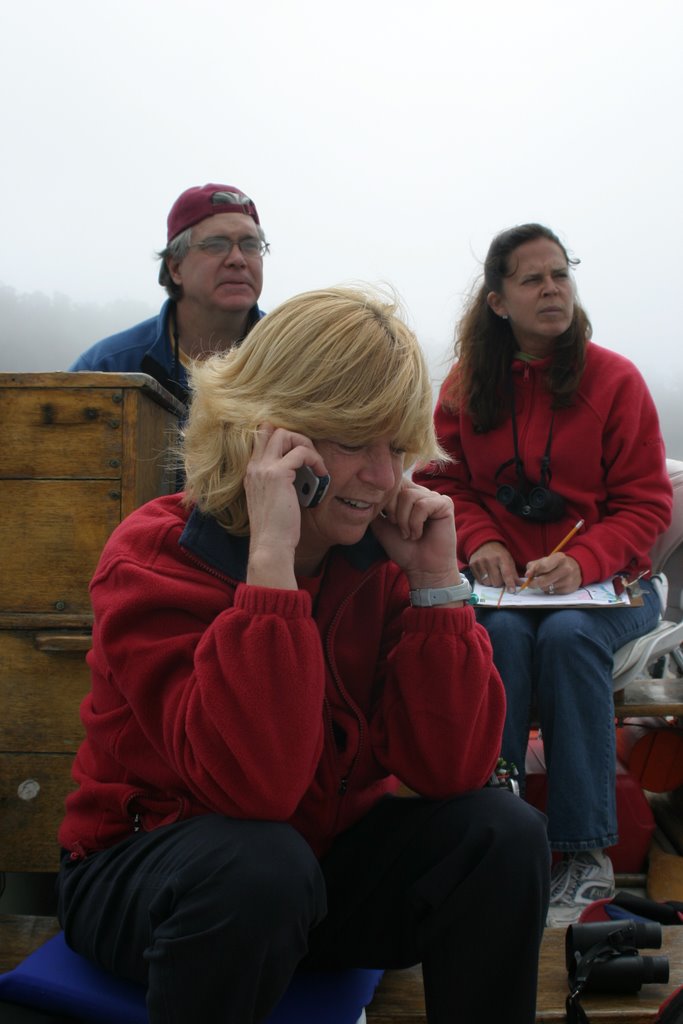
Donna Konkright (Team 3) has been nominated for the Presidential Award for Excellence in Science and Math Teaching! Way to go Donna! While Donna was in Monterey, she kept in touch with her seventh graders from Osborn Middle School in Phoenix, AZ. Donna posted journal entries, photos, and answered student questions on her blog. In the picture to the right, Donna's making a call to her students to tell them how many otters were spotted on the census!

The write up on their experience in Monterey written by Robert (Team 5), Celine (Team 4) and Eugene (Team 6), together with some photos has been published in Malta's most popular Sunday newspaper - The Sunday Times! Published on 21 January, 2007.
Donna Konkright (Team 3) has been nominated for the Presidential Award for Excellence in Science and Math Teaching! Way to go Donna! While Donna was in Monterey, she kept in touch with her seventh graders from Osborn Middle School in Phoenix, AZ. Donna posted journal entries, photos, and answered student questions on her blog. In the picture to the right, Donna's making a call to her students to tell them how many otters were spotted on the census!
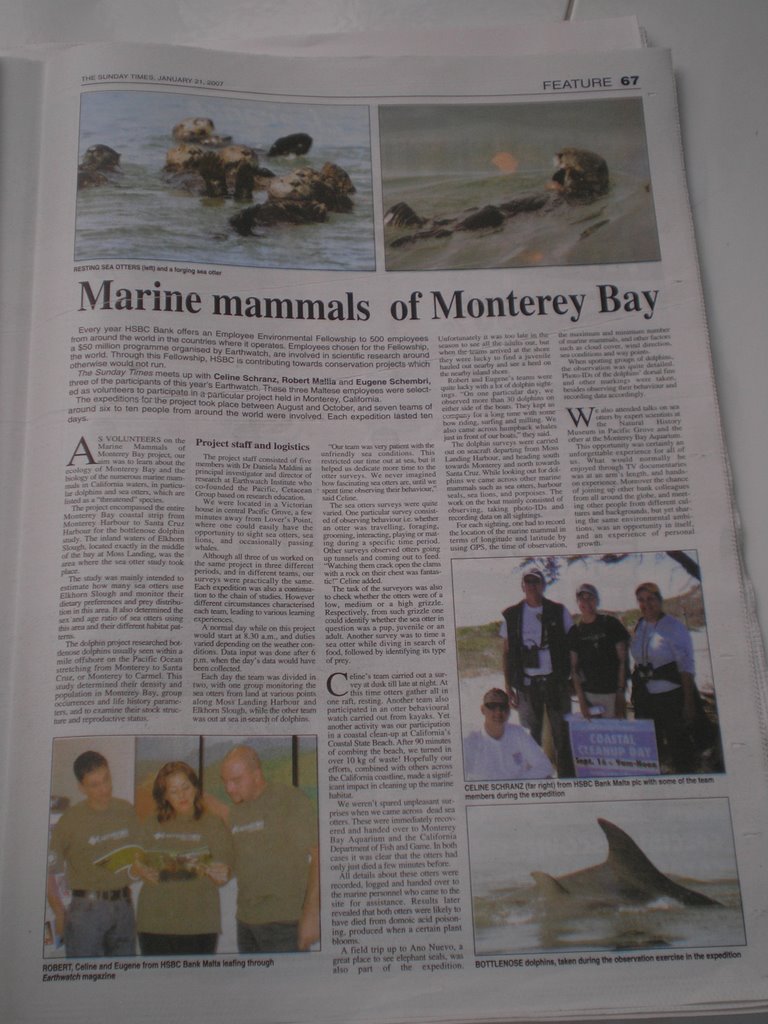
The write up on their experience in Monterey written by Robert (Team 5), Celine (Team 4) and Eugene (Team 6), together with some photos has been published in Malta's most popular Sunday newspaper - The Sunday Times! Published on 21 January, 2007.
Friday, December 15, 2006
News from Malta submitted by Robert, Team 5:
Last Sunday 3rd December, the HSBC Cares for the Environment Fund (HCEF) - Malta, organised a tree planting activity for HSBC staff and their families at a place called Xrobb l-Ghagin in Marsaxlokk. (The Xrobb l-Ghagin project site is a major project in the south of Malta and will be used for afforestation, educational and recreational purposes. The HCEF is the main contributor of the afforestation part of the project and is contributing over three years to plant a total of 15,000 trees.)
Also there was an ecological guided walk of the park and during the rest of the day animators entertained us with games.
Attached please some photos of this activity with my wife and kids. Also in the photo is Eugene from Team 6.
Also as part of our local environmental project, Celine, Eugene and myself and possibly other staff members will be collaborating with an organisation called BICREF (Biological Conservation Research Foundation) led by Dr. Adriana Vella Ph.D. who is a senior lecturer at the University of Malta and a conservation biologist. Their work is mainly based on dolphins around the Maltese islands and they been doing this research since 1996. Please take a look at their site http://sites.keyworld.net/bicref
Merry Xmas and a Happy New Year to all.
Last Sunday 3rd December, the HSBC Cares for the Environment Fund (HCEF) - Malta, organised
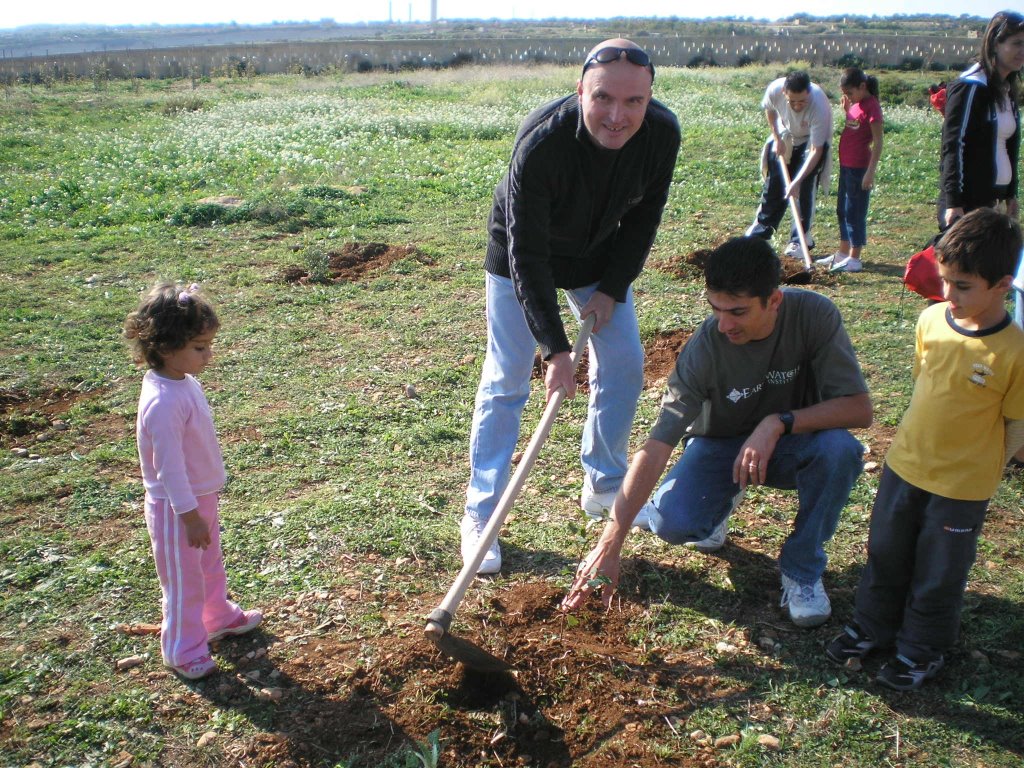 a tree planting activity for HSBC staff and their families at a place called Xrobb l-Ghagin in Marsaxlokk. (The Xrobb l-Ghagin project site is a major project in the south of Malta and will be used for afforestation, educational and recreational purposes. The HCEF is the main contributor of the afforestation part of the project and is contributing over three years to plant a total of 15,000 trees.)
 Also there was an ecological guided walk of the park and during the rest of the day animators entertained us with games.
Attached please some photos of this activity with my wife and kids. Also in the photo is Eugene from Team 6.
Also as part of our local environmental project, Celine, Eugene and myself and possibly other staff members will be collaborating with an organisation called BICREF (Biological Conservation Research Foundation) led by Dr. Adriana Vella Ph.D. who is a senior lecturer at the University of Malta and a conservation biologist. Their work is mainly based on dolphins around the Maltese islands and they been doing this research since 1996. Please take a look at their site http://sites.keyworld.net/bicref
Merry Xmas and a Happy New Year to all.
Tuesday, December 12, 2006
 Update from Renee, Team 7:
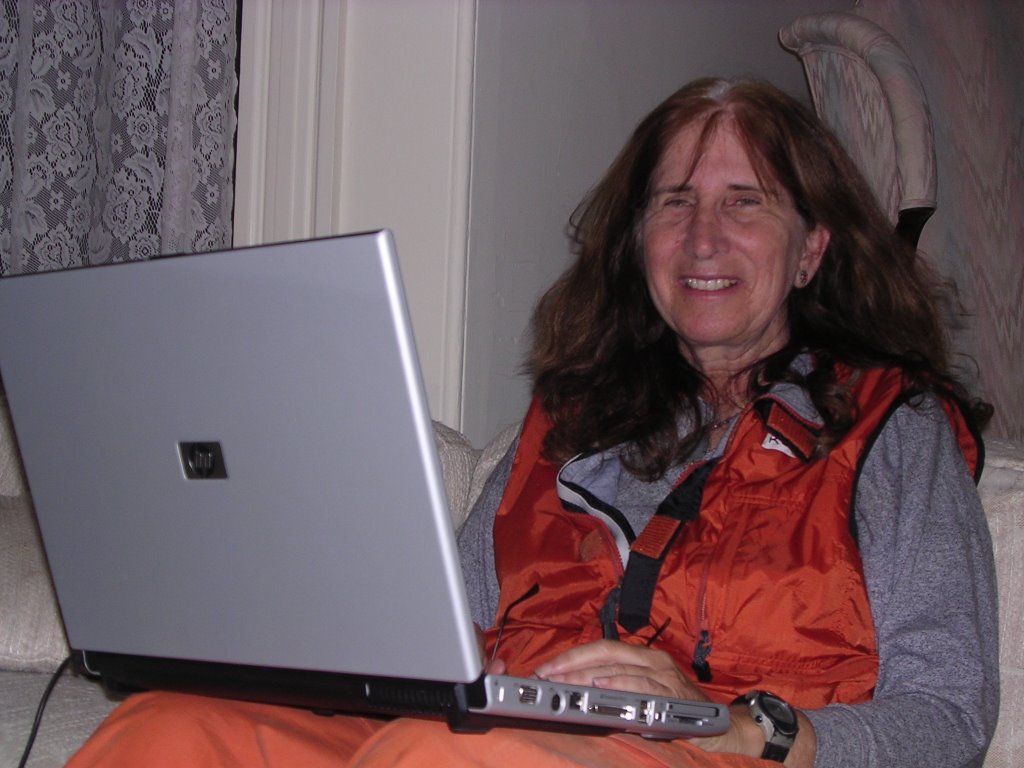
I have been able to present the Monterey Bay marine mammal program to grades k-8, over 300 children. They have really enjoyed the pictures and stories. They have many questions each time we share the project and stories of their own too! It has been engaging and fun for them.

The pic was taken at the Cabrillo tidepools in San Pedro. We are involved in a watershed/ conservation project; to minimize run-off into the ocean. We are addressing the environmental issue of too much wasted water through improving land and garden irrigation. I will send more info/ lessons, etc. as we develop them.
Friday, December 08, 2006
Greetings from Hong Kong,
Hello there, Tom Jefferson here. I have been in Hong Kong for the past month or so, conducting research on Indo-Pacific humpback dolphins (Sousa chinensis). Team 3 members will remember that I have been working on these dolphins for almost 12 years. We have learned a great deal about these dolphins over the past decade, but there are still some important conservation questions that remain unresolved. One of these is: How are the high levels of pesticides and other organochlorines in the dolphins' environment affecting their health and survival?
To answer that question, we have crafted a program in which we collect small bits of skin and blubber from living dolphins by using a crossbow and lightweight darts that are designed to only penetrate about an inch into the dolphins' bodies. These biopsy samples can tell us much.
So, for the past few weeks I have been spending my days out on the water searching for dolphins and attempting to collect biopsy samples when we see them. Weather problems, and the unpredictability of dolphin behavior have made things more difficult than originally expected. We have only been able to collect 9 samples in as many days at sea. We are hoping that our luck will improve and we can collect most of our remaining 14 samples in the next 10 days or so. Wish us luck…
Since heading overseas, I also have also done a side-trip from Hong Kong. I spent 12 days in the Maldives (for those of you who don't know where that is, look at a world map or globe and search just southwest of the tip of India). This Indian Ocean country consists of several hundred islands perched on low coral atolls - the highest point in the country is only 10 feet above sea level. Obviously, Maldivians are quite concerned about global warming and subsequent sea-level rise!!
In the Maldives we searched for whales and dolphin every day, and found a wide variety of species - spinner dolphins, spotted dolphins, striped dolphins, common bottlenose dolphins (same species as our friends in Monterey Bay… ), Blainville's beaked whales, dwarf sperm whales, and sperm whales. We even had the first confirmed record of the Indo-Pacific bottlenose dolphin in the Maldives! But, the highlight of the trip, to be sure, was the sighting of two large (200+) schools of Fraser's dolphins. This is a species of dolphin that was virtually unknown until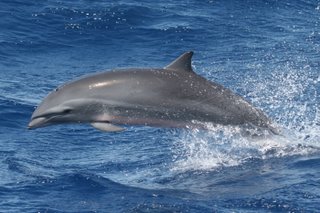 1973, when the first specimens were examined, allowing us to finally know what it looked like. Previous to that it was only known from a single skull in the British Museum of Natural History. It turns out that the species is not really rare, but there is still quite a bit of mystery about it. The photograph shows the short beak, tiny dorsal fin and flippers, and unique color patttern that characterize the species.
Although the work that we are doing in Asia may seem more exotic than Monterey Bay, we are actually using many of the same research techniques, and there are some interesting similarities. Perhaps some of the lessons we learn will help us next year in Monterey Bay!
Live well,
Tom
Hello there, Tom Jefferson here. I have been in Hong Kong for the past month or so, conducting research on Indo-Pacific humpback dolphins (Sousa chinensis). Team 3 members will remember that I have been working on these dolphins for almost 12 years. We have learned a great deal about these dolphins over the past decade, but there are still some important conservation questions that remain unresolved. One of these is: How are the high levels of pesticides and other organochlorines in the dolphins' environment affecting their health and survival?
To answer that question, we have crafted a program in which we collect small bits of skin and blubber from living dolphins by using a crossbow and lightweight darts that are designed to only penetrate about an inch into the dolphins' bodies. These biopsy samples can tell us much.

So, for the past few weeks I have been spending my days out on the water searching for dolphins and attempting to collect biopsy samples when we see them. Weather problems, and the unpredictability of dolphin behavior have made things more difficult than originally expected. We have only been able to collect 9 samples in as many days at sea. We are hoping that our luck will improve and we can collect most of our remaining 14 samples in the next 10 days or so. Wish us luck…
Since heading overseas, I also have also done a side-trip from Hong Kong. I spent 12 days in the Maldives (for those of you who don't know where that is, look at a world map or globe and search just southwest of the tip of India). This Indian Ocean country consists of several hundred islands perched on low coral atolls - the highest point in the country is only 10 feet above sea level. Obviously, Maldivians are quite concerned about global warming and subsequent sea-level rise!!
In the Maldives we searched for whales and dolphin every day, and found a wide variety of species - spinner dolphins, spotted dolphins, striped dolphins, common bottlenose dolphins (same species as our friends in Monterey Bay… ), Blainville's beaked whales, dwarf sperm whales, and sperm whales. We even had the first confirmed record of the Indo-Pacific bottlenose dolphin in the Maldives! But, the highlight of the trip, to be sure, was the sighting of two large (200+) schools of Fraser's dolphins. This is a species of dolphin that was virtually unknown until
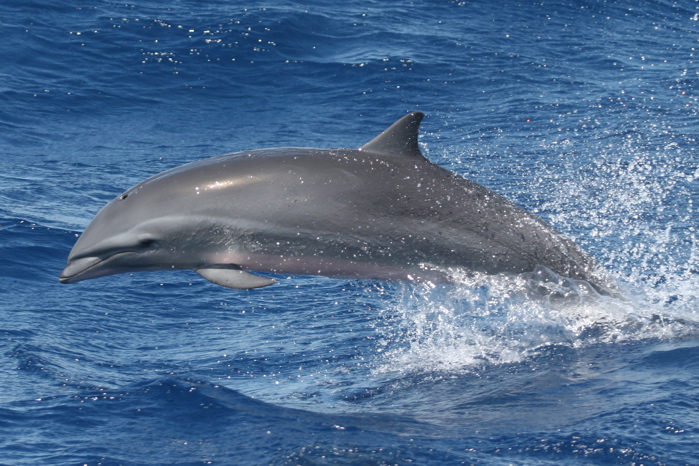 1973, when the first specimens were examined, allowing us to finally know what it looked like. Previous to that it was only known from a single skull in the British Museum of Natural History. It turns out that the species is not really rare, but there is still quite a bit of mystery about it. The photograph shows the short beak, tiny dorsal fin and flippers, and unique color patttern that characterize the species.
Although the work that we are doing in Asia may seem more exotic than Monterey Bay, we are actually using many of the same research techniques, and there are some interesting similarities. Perhaps some of the lessons we learn will help us next year in Monterey Bay!
Live well,
Tom
Tuesday, December 05, 2006
Speaking of right whales....
 A note from Marie, Team 7:
Now I finished my first presentation on my expedition to my boss/colleague and I have two more presentation within this fiscal year. I shared my experience with my colleagues and they were very pleased to see the great pictures of humpback wheals that Peter took our first day. One of my colleagues provided me of the information about a regulation to protect right whales in east coast. I remember Peter told me that a merchant ship is a problem for whales to hit and kill them during their traveling. My colleague told me that it seems difficult for Japanese Government to impose the similar legal controls around the Japanese neighboring waters. I feel guilty as an employee of a shipping company. In my next presentation to the employees in my company including top management, I will remind them of this problem.
An article submitted by Lynn, Team 5:
Mating Season Can Be Perilous for Right Whales
A note from Marie, Team 7:Now I finished my first presentation on my expedition to my boss/colleague and I have two more presentation within this fiscal year. I shared my experience with my colleagues and they were very pleased to see the great pictures of humpback wheals that Peter took our first day. One of my colleagues provided me of the information about a regulation to protect right whales in east coast. I remember Peter told me that a merchant ship is a problem for whales to hit and kill them during their traveling. My colleague told me that it seems difficult for Japanese Government to impose the similar legal controls around the Japanese neighboring waters. I feel guilty as an employee of a shipping company. In my next presentation to the
 employees in my company including top management, I will remind them of this problem.
An article submitted by Lynn, Team 5:
Mating Season Can Be Perilous for Right Whales
Saturday, December 02, 2006
 A note from Elizabeth, Team 2:
 We are fast approaching "whale watch" season. Those beautiful gray behemoths will be heading to within viewing distance of many habitual observers on their southern migration during December and January. There is a well trained (by Bruce Mate, et al) plethora of whale watch volunteers who station themselves along the Oregon coast twice a year. They announce their presence with "Whale Watching Spoken Here" placards and offer interested observers written information about cetaceans and pinnepeds, show small models of females and young, and run a 45' rope along the ground to illustrate the body length of gray females. They offer binoculars for observing and samples of baleen to touch. They also keep records of visitors' home states/countries. Amazing the number of people from abroad!
Historically, the gray whales are farther out to sea during winter months, not only to avoid the rough weather waves in shore but also to enable them to swim more swiftly in deeper water, so they are usually harder to spot without binoculars. Although, on one occasion, through a wall of dense fog, a whale watch volunteer and I clearly heard a series of blows! Very eerie - quite sensational!
The sun is out and it is HAILING. This coastal weather is a mystery to me! Sort of like Monterey!
Monday, November 27, 2006
 Volunteers on teams 4, 5, and 6 certainly had the pleasure of meeting one of our HSBC fellows from Malta: Celine, Robert and Eugene all came from this small island in the Mediterranean to make a big contribution to our efforts in Monterey. As part of their fellowship, they must spreak the word about their adventure to their colleagues and community. Below are some excepts from the write-up they submitted to HSBC Malta and their local media.
"2006 was the final year of this five-year Partnership with Earthwatch. During these years, 2000 HSBC employees worldwide, together with experienced scientists, worked as field assistants on international research projects. The objective of these expeditions was to give employees the opportunity to make an active contribution to a conservation research project and to the environment in general. Three Maltese employees, namely Celine Schranz, Robert Mallia and Eugene Schembri were selected as volunteers to participate on one particular project in Monterey, California, USA The Marine Mammals of Monterey Bay Project. The expeditions took place between August and October, and seven different teams where involved. This participation was possible thanks to the full sponsorship, and as part of HSBC’s global Corporate Social Responsibility. This project laid particular emphasis on Bottlenose Dolphins and Sea Otters. Each expedition lasted ten days, and teams were made up of around 6-10 people from all over the globe. "
...
"On a particular day, Robert’s team was out at the field at 05:30am to observe the different behaviour patterns at different times of the day. In fact initially they counted the number of Sea Otters in the Slough, which in those early hours amounted to about 80, but which by noon had reduced to 45. Such observation revealed that after sunrise Sea otters move, either out in the Ocean or up towards Elkhorn Slough. Celine’s team on the contrary carried out a survey at dusk till late at night. At this point all otters gathered all in one raft and most of them were just resting. The same team, as well as Eugene’s team, also carried out an “Otter Census” in the slough, with Tom Kiekhefer the chief surveyor on the census."
...
"Another interesting activity from Celine’s group was participating in a Coastal Clean Up Day at California’s Coastal State Beach. This Clean-Up Day was organized by the Ocean Conservancy, and the group agreed that it would benefit otters and dolphins. They were provided with two sets of bags- one for garbage and one for recyclables and they also took along a data sheet to keep track of select items that were found such as cigarette butts, food wrappers, boating materials etc. Along the beach, they encountered all types of debris, such as a few dead marine mammals which included a harbour seal and a very bloated sea lion. They also found lots of balloons, which are extremely harmful to marine wildlife. After 90 minutes of combing the beach, they turned in 25lbs of waste! Hopefully their efforts, combined with others across the California Coastline, made a significant impact in cleaning up the marine habitat."
...
"Robert and Eugene’s teams were quite lucky with a lot of Dolphin sightings. In fact on one particular day, they could observe more than 30 dolphins which were on either side of the boats. They kept them company for a long time with some bow riding and others surfing and milling. Both teams came across Humpback Whales just in front of their boats. "
...
"This opportunity was certainly an unforgettable experience for all the 3 Maltese participants. What could normally be enjoyed through TV documentaries was at an arm’s length, and a hands on experience. Moreover the chance of joining up other bank colleagues from all around the globe, and meeting other people with different cultures and backgrounds, but yet sharing the same environmental ambitions, was an opportunity in itself. Surely an experience that left an impact at a personal level which will encourage others to participate in and contribute the HSBC’s monetary grant towards Malta’s environmental projects."
Thank you, Robert, for submitting this for the blog!
Celine, Robert Eugene- we look forward to hearing about your community project!
Monday, November 20, 2006

Update from Daniela: (charts with data analysis to come- Anna)
Dear Teams,
The season is really over. The house has been locked, the staff is returning home from the field and there is lots and lots of work to do to analyze the data, summarize the information and, yes…prepare for next year. Our field season is starting again next August and will again run until the end of October. There will be some slight changes based on your observations, your comments and the evolution of the work as we get answers to some questions and move on to others. One big change is going to be the accommodations. Although Pacific Grove served us well as a base and I love the town, we would like to be closer to the field and to the animals so we decided to move to Pajaro Dunes Colony. You have seen it…from the boat: that funky line of houses right on the beach. Well, that will be our new base. The house is very nice and close to the beach…maybe not as big as the Pacific Grove one but certainly close to Moss Landing and the wildlife.
Peter has been driving back to Massachusetts with the car and the data. He will be home today. I was in Mexico where I attended a marine mammal conference and then in Florida where I attended another that was especially interesting because of the sea otter workshop which gave me a lot to think about. It was the perfect motivator to get me to look at some of our data from this summer. I looked at the 5-minute sampling intervals that you and the staff collected from the parking lot in Moss Landing throughout the day looking at the sea otter raft and the other otters around it. The story is not surprising but interesting. Most of the sea otters observed in Elkhorn Slough are juvenile males, which confirms that the slough is still a male area and one where juvenile males spend their maturing years waiting to move out and possibly become territorial males by competing with the current “kings of the harems”. Some of them will become harem holders and others will perish trying or will be confined to peripheral areas perhaps managing to sneak into a territory every once in a while and mate with a female while the boss is busy. The interesting question is: How many of these juveniles will actually become territorial males and how many will make it? There is no answer for now and pursuing the question will take some collaborative efforts with other researchers and more funding, but we are exploring this possibility.
In the meantime, back in the slough these animals spend most of their time resting in Area 2, in the large raft you have observed, and foraging (but not in Area 2). We are looking at the data for indications of where most of the foraging occurred. We know that the slough main channel on both sides of the highway bridge is an important foraging area; however, the open ocean just in front of Moss Landing seemed to be as important this year. Figure 1 gives you the frequency of occurrence of the behaviors you have observed in Area 2 through the summer (this is part of the data you have helped collect!). Sea otters rested 47% of their time, groomed 23%, interacted with one another 11%, moved in and out or within Area 2 9% of the time and only foraged 1% of the time in this area. Most of the foraging occurred outside of Area 2.
The largest numbers of otters in Area 2 were found early in the morning between 6 and 7 am, and the numbers varied widely throughout the day. However, the number of otters tended to decrease later in the morning, increase again around noon and decrease in the afternoon as animals went out to forage and use other areas of the slough or offshore. Knowing when otters rest is important. Disturbance of resting patterns by boats and people may affect their ability to recuperate in between energetically demanding foraging trips. When sea otters rest, they become dry and warm which saves them a lot of energy. When they are disturbed, they dive or roll and become wet, therefore consuming more calories to stay warm. Continuous disturbance may therefore have effects on their health as they need to forage longer hours to recuperate calories lost. By identifying times of day and locations of resting areas we can suggest to the public appropriate behaviors to ensure diminished disturbance. Our initial data are giving us a good clue. We are going to continue to test the hypotheses I just mention to figure out the costs of disturbance to sea otters. Thanks for your help in getting these results.
There is still much more data to analyze and I will keep you posted. I wish you all a Happy Thanksgiving (for Americans!) and a great Holiday season.
All the best
Daniela
Monday, November 13, 2006
Thursday, November 02, 2006
 Anna J on the road:
It was very sad to leave the Monterey Bay area, but to my suprise, I caught another glimpse of our friendly cetaceans. It was a beautiful drive down Rt 1 and around Morro Bay we spotted dolphins in the surf!! I quickly pulled the car over, grabbed the camera and ran to the shore line for some photo ID. I couldn't get as close as we normally do in the Astirix (unless I decided to jump into the waves). But you never know, with Daniela or Shinae's careful eye, we might be able to identify these animals as our pals from Monterey!
In addition to the TUTRU, we also recorded MIRAN at Piedras Blancas and MENO at Morro Bay.
5 POINTS to the first past-team-member to leave a comment correctly identifying these marine mammal species with their species codes and common names!


Subscribe to:
Comments (Atom)